
Date: November 11th, 2025
Sessions: 8:00 AM | 2:00 PM | 8:00 PM (UTC/GMT +2)
Keynote speakers

Francesca Romana Pellegrini – Post-Doc Researcher at the Institute of Molecular Biology and Pathology (IBPM) | CNR, Rome, Italy
Francesca Romana Pellegrini is a postdoctoral researcher at the Institute of Molecular Biology and Pathology of the National Research Council (CNR) in Rome. Her research focuses on elucidating the role of autophagy in cancer biology. Throughout her career, she has cultivated a strong interest in imaging-based approaches to study this process, with particular emphasis on developing automated pipelines to quantitatively analyze its dynamic progression. Her current work investigates the function of ATAT1, the sole microtubule acetyltransferase of the mammalian system, in the regulation of autophagy, cellular metabolism, and cancer cell death mechanisms.
Federica Polverino – Post-Doc Researcher at the Institute of Molecular Biology and Pathology (IBPM) | CNR, Rome, Italy
Federica Polverino is a AIRC postdoctoral fellow working at the Institute of Molecular Biology and Pathology of the National Research Council (CNR) in Rome. During her research experience, she developed a strong interest in chromosomal instability and its impact on cell transformation, a field that has greatly benefited from recent groundbreaking advances in cellular imaging. These technological innovations have made it possible to visualize the behaviour of individual biological entities, from cells to chromosomes and molecules, thereby shedding light on tumor heterogeneity and opening unexpected therapeutic opportunities. She has found enthusiasm in projects that integrated these two aspects: the use of advanced cellular imaging methodologies and the investigation of genome stability regulation by the mitotic Aurora-A kinase and its molecular partners.

Laura Ferrucci – Application Specialist at CrestOptics, Rome, Italy
Laura Ferrucci is a Neurobiologist and Application Specialist in advanced microscopy. After earning her PhD in Neuroscience, she pursued a postdoctoral fellowship investigating glia-neuron communication and the role of glial cells in synaptic modulation. She currently works as an Application Specialist at CrestOptics, where she supports researchers in high-end imaging applications and correlative microscopy workflows.
In this webinar, we will explore how the X-Light V3 spinning disk confocal system enables gentle yet high-performance imaging, making extended time-lapse experiments easier and more reliable.
Long-term live-cell imaging is a powerful approach to studying dynamic biological processes with high temporal and spatial resolution but maintaining cell viability over time remains one of the biggest challenges for researchers. Imaging conditions can often be too harsh, leading to phototoxicity and photobleaching that compromise both cell health and data quality.
Through real-world case studies, we will demonstrate how researchers can achieve:
- Reduced phototoxicity and photobleaching
- High acquisition speed and precise optical sectioning
- Robust quantitative analysis over hours of imaging
- Preserved cell viability in long-term live experiments
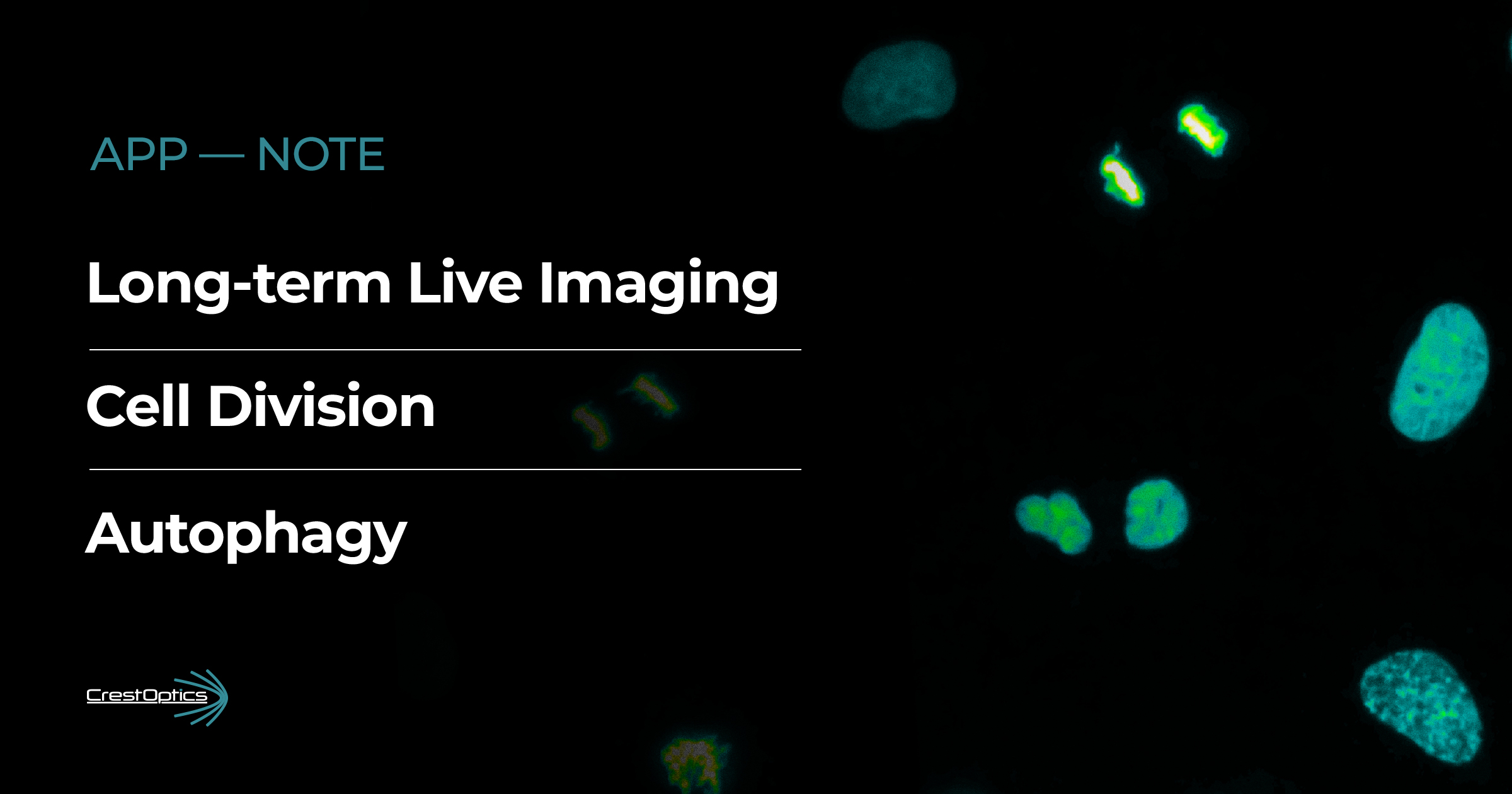
In particular, Dr. Francesca Romana Pellegrini will present her work on autophagy, showcasing how live-cell imaging enables the study of complex cellular degradation and recycling mechanisms over extended periods of time. Dr. Federica Polverino will focus on cell division, highlighting how long-term live imaging allows for detailed observation of mitotic dynamics while preserving cell health and image quality. Furthermore, Dr. Laura Ferrucci from CrestOptics will describe our spinning disk technology and its significant impact on the field of imaging and biological research
Join us to learn how to capture more and damage less, while unlocking new possibilities for long-term live-cell imaging.
Webinar details
This webinar will be broadcast on the ZOOM platform with subtitles available in various languages. A live Q&A session will follow the presentations offering the audience the opportunity to pose questions to the panelists. The webinar recording will be available to re-watch the event on demand. The webinar will conclude with a survey.
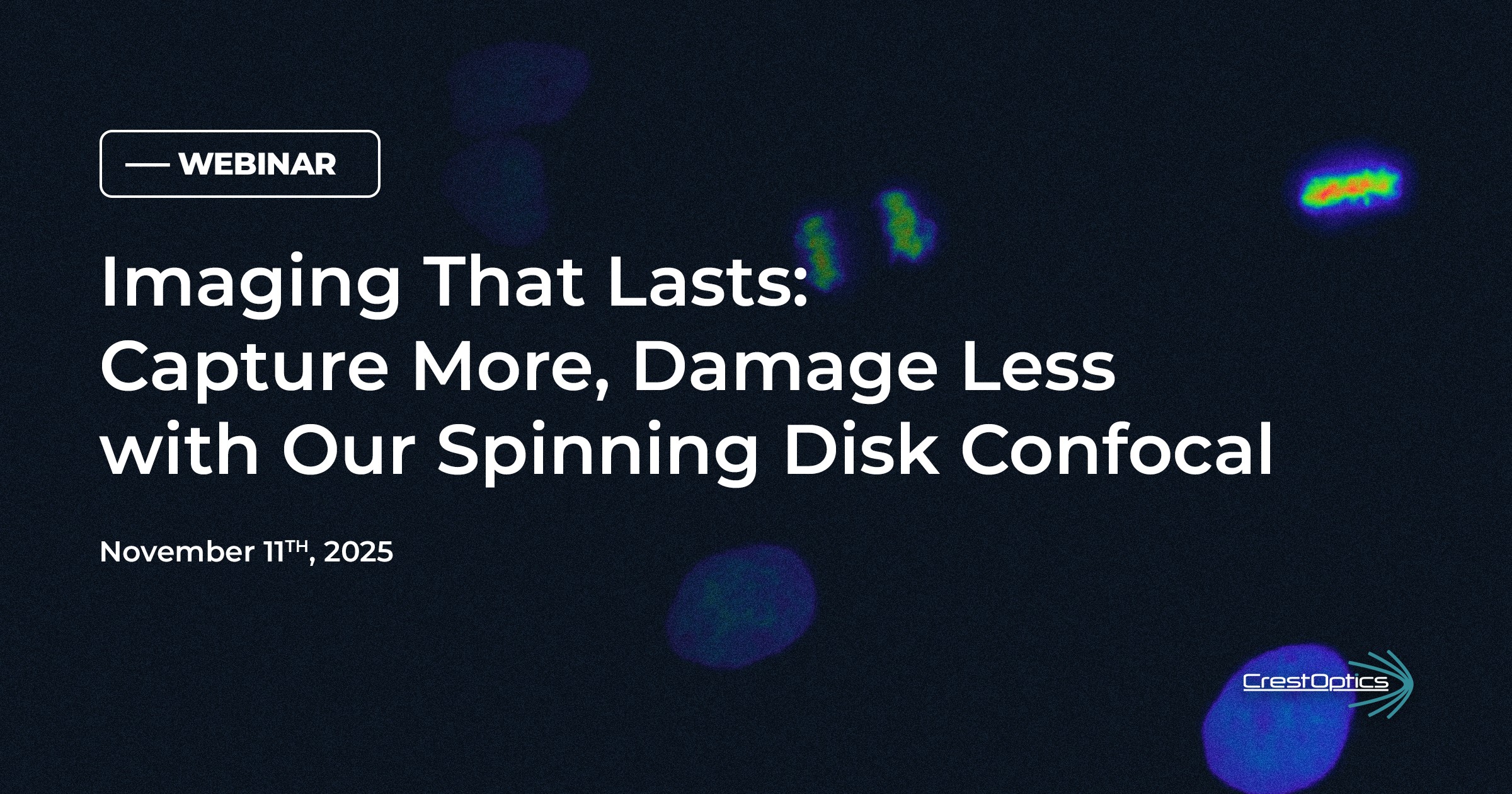
Cover image: from the study by IBPM Intitute featured in our recent Application Note.